


Creating the White Rabbit level for Reach
Updated: Aug 15
White Rabbit (approx 15-30-mins playtime) is one of Reach’s early levels, and serves to introduce the player to the underground setting where they’ll spend most of their playtime. I worked on this level from its initial paper designs through to completion.
Research & Planning
Work on White Rabbit began with research. I created a list of mechanics already understood by the player by this point in the game, and a list of the major narrative beats they’d have experienced.
Working with my Level Design Lead (Michael Michael) and one of Reach’s writers (Frankie Wakefield-Harrey) I next determined what the player would need to learn throughout White Rabbit, both in terms of mechanics and narrative.
This gave me a skeleton of beats I needed to hit with my level design, and from this I was able to create a level flow chart and intended pacing breakdown.

It was crucial to achieve varied pacing throughout, giving the player moments of excitement followed by slower-paced moments to allow them to catch their breaths and process what they'd just experienced.
I sought feedback from design, narrative, and environment, made a few changes and iterations, then created a 2D map in Photoshop to better illustrate my intentions, drawing on concept art and early environment art test levels as inspiration.
Due to hardware limitations, gameplay environments in Reach had to be relatively small. My plan included loading doglegs disguised in a number of ways, including shimmy spaces, crouch spaces, sliding slopes, and regular hallways. This fit with the theme (the aftermath of an earthquake lends itself to contextualising tight spaces) and helped avoid the 'box-corridor-box-corridor' feel that the level could have suffered from.

I again received and incorporated feedback from various departments before seeking approval for a second version of the layout and beginning a 3D blockout.
Blocking Out White Rabbit
At this point in Reach, the game’s protagonist has just fallen underground and has set themselves the objective of reaching the safety of the surface. My objective as a designer, however, was to take the player deeper and deeper underground.
I tackled this using a repeated pattern of presenting the player with an obvious upwards path, then sending the player further down via a scaffold collapsing or a handhold unexpectedly giving way. This helps the player feel more of the panic that their character is expressing, and means the world crumbling around them isn’t just set-dressing but an active part of their journey. I was careful not to repeat this pattern too often, and made sure each presentation of it was different from the last to avoid repetition.
To make the environment feel unstable, I incorporated plenty of movement and miniature set-pieces, scaling all the way from individual handholds breaking all the way up to a bus crash.
The width of gameplay spaces throughout the level varies from area to area, with some spaces feeling deliberately claustrophobic and others (namely the mid-point vista) feeling enormous by contrast. Pace tended to follow gameplay width, with smaller spaces lending themselves to slower gameplay beats, and larger spaces meaning more involved set-pieces and impactful moments.
Blockout vs Final Images

The player wakes here. Above, they catch glimpses of the sky but cannot reach it. The fallen crane segment was later moved much further up to ensure player’s didn’t mistakenly think it was climbable.

The player begins to see ghostly apparitions guiding the player through the level. These apparitions were later replaced with a helpful drone companion fulfilling the same role. The drone leads the player towards the opening on the far side, but the scaffolding collapses as the player leaps onto it, plunging the player further underground.
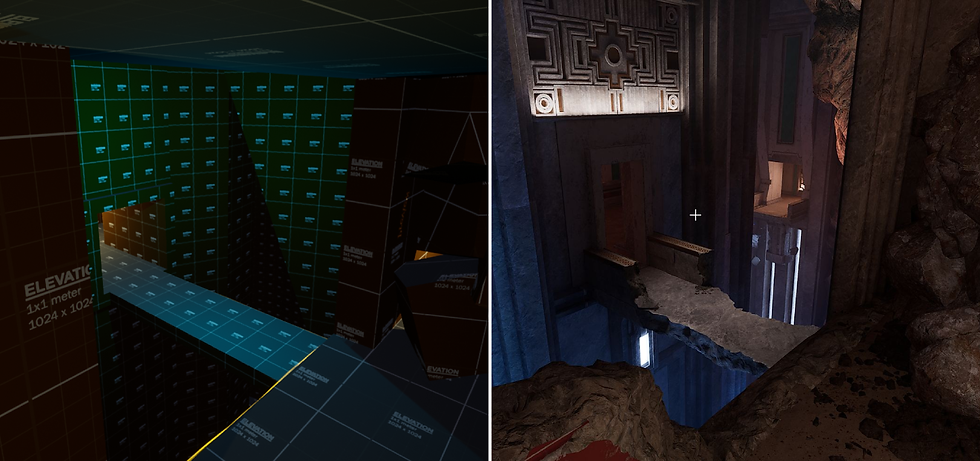
All jumps and climbing routes were metrics compliant to provide the player with the best experience possible. This particular jump, from a high ledge onto a diagonal bridge was repeatedly called out as a playtester favourite.
Iteration & Pacing Changes
With feedback in hand on my first-pass blockout, I began iterating and fleshing out the beats in every area. I implemented placeholder level sequences for both narrative moments and action set pieces. These included collapsing cranes, unstable flooring, fracturing climbing routes, and more glimpses of the player’s guiding apparition.
All of this helped me develop and refine White Rabbit’s pacing, and in version two of the blockout, several areas were added, cut or revamped to improve the player experience.

While it was a fun idea, this area where the player had to climb along the underside of a bus was cut. It was too similar to the beats before and after, and made the level’s pace too slow.

An intense beat where the player has to climb up a collapsing crane was added. Between the initial blockout version and the final, climbing routes up the sides and back of the crane were removed, and more 'safe' grips were added to the wall on the right to give the player ample chance to save themselves. This is one of the first potentially lethal let pieces in Reach, so I wanted it to be fairly forgiving. It's also precluded by a section with crumbling ceilings, walls, and floors, increasing the pace ahead of the crane climb so it doesn't come out of nowhere.
Spreading out the ‘Weird’
White Rabbit serves as the player’s introduction to Reach’s ancient underground civilisation, but their arrival within it doesn’t happen all at once. Instead, the ‘weird’ ramps up slowly throughout the level, with the player seeing unusual insects and a peculiar drone early on, before encountering strangely floating objects, then dropping into an ancient hallway.

Pacing out the ‘weird’ aspects of the level helps build anticipation throughout, culminating in the reveal of the underground city around halfway through.

The first and final versions of the underground city vista. The angle of entry to this area changed in later versions, putting the vista directly ahead of the player rather than off to the side. Doors were also added, providing the player with a slow, satisfying reveal as the doors slide open.
The Vista reveal beat acts as White Rabbit’s turning point, and after a low-drama beat that gives players time to explore a section of the underground city (a mirror of an earlier above-world beat), the player finds a weapon right before being introduced to the first of Reach’s main hostiles.

The blockout and final versions of the room where the player finds their bow. The original idea was inspired by the Moria troll battle from The Fellowship of the Ring, showing the aftermath of a battle in some catacombs. The player would take the bow from a skeleton wedged in the door. While the idea of the catacombs stayed, the skeletons didn't, and the bow was instead placed reverently on a plinth.
Iterating the Puzzle Room
White Rabbit culminates with an introduction to puzzle solving in Reach. The player is tasked with using their bow and arrow to open an ancient door. This demonstrates one of Reach’s core themes: that weapons and tools have multiple uses.

The puzzle itself is fairly simple, teaching the player that they can climb arrows embedded in walls before testing their understanding of both this new mechanic and the already-introduced mechanic of shooting buttons to activate objects.
While the concept of the puzzle remained similar throughout development, aspects of the room were changed due to player feedback. Players were struggling to understand how aspects of the puzzle linked to one another, and a timed element to the climbing on one side of the room proved too fiddly for many players this early in the game.

The final version of this room placed the back walls at an angle and removed anything obscuring puzzle elements from view. This meant that all puzzle elements could be seen as the player entered the room. The moving, timed elements of the climb were removed in favour of a simpler, static climb up the right-hand side. In subsequent playthroughs, players found this puzzle much more satisfying to solve.


Comments