


Creating the Ultimate Combat Gauntlet in Reach
I was responsible for creating several combat encounters throughout Reach, from small-scale encounters designed to introduce enemy types, to larger multi-wave encounters designed to test the player’s abilities.
This article delves into the creation of an encounter I lovingly refer to as ‘The Gauntlet’.
Running the Gauntlet - Design Goals
The Gauntlet is a combat encounter occurring in Reach’s final level. Before beginning designing the space, I established what I wanted the encounter to achieve, and what about it was most important.
This is the final combat encounter of the game, so I wanted to provide a test of the player’s skills
And provide a lengthy combat encounter that escalates as time goes on
I repeatedly played other combat encounters in the game to get a feel for what the player had experienced up until that point, as well as combat encounters in games like Uncharted (run & gun, cover shooting) and Batman Arkham Knight (stalking enemies from above), both of which had been used as reference at various points.
Initial Designs
I next created paper designs for a multi-tiered room complete with enemy locations, gameplay objects, and player resources. The setting for the room was that of an underground public space that had seen better days. Walkways around the edge of the room had crumbled away, providing interesting vantage points for players and enemies alike, as well as up and down traversal routes. A pair of large double doors were a focal point in the room, clearly signposting where the player needs to go once the combat encounter was complete.
With approval from level design and environment leads, I progressed to 3D blockout, iterating on the initial designs while building. I used everything I’d learned in making earlier combat spaces to develop flowing combat routes and waves of enemies that got more threatening over time.
There was a problem, though…
The feel of the combat space was too similar to everything that had come before it. It didn’t feel like some grand combat encounter that was the ultimate test of the player’s skills. Combat felt flat. After several iterations that didn’t solve anything, I went back to the drawing board.
Revisiting the goals
I decided that the goals I had set for this combat arena were the problem. They were too similar to goals I’d used for developing previous encounters. I needed to get more ambitious, and given that this combat encounter immediately precedes the final boss encounter, perhaps I could make use of the game’s primary antagonist. I set myself some new goals:
Maintain a sense of forward momentum
Use the primary antagonist’s presence to change the feel of combat
Test of the player’s skills
Provide a lengthy combat encounter that escalates as time goes on
With these in mind, I evolved the combat encounter in a different direction, taking away the floor, raising the exit doors to the upper level, removing a number of walkways, adding gigantic pillars, and transforming it from a freeform combat encounter into a more directed encounter where the player has to battle through waves of enemies to reach the top floor.
The Gauntlet is Born
The revamped version of the Gauntlet immediately limits the amount of space the player has available, with the game’s primary antagonist (Lithos) blowing up the bridge in front of them. After several waves of low-threat enemies, explosives demolish a wall and reveal a path for the player.

As the player moves through, more paths are revealed, with grapple bars providing routes to the encounter’s middle level. Enemy spawns change depending on the player’s position, and as they progress up the room, enemy variety increases, with low-threat enemies replaced by shotgunners and shield-bearers.
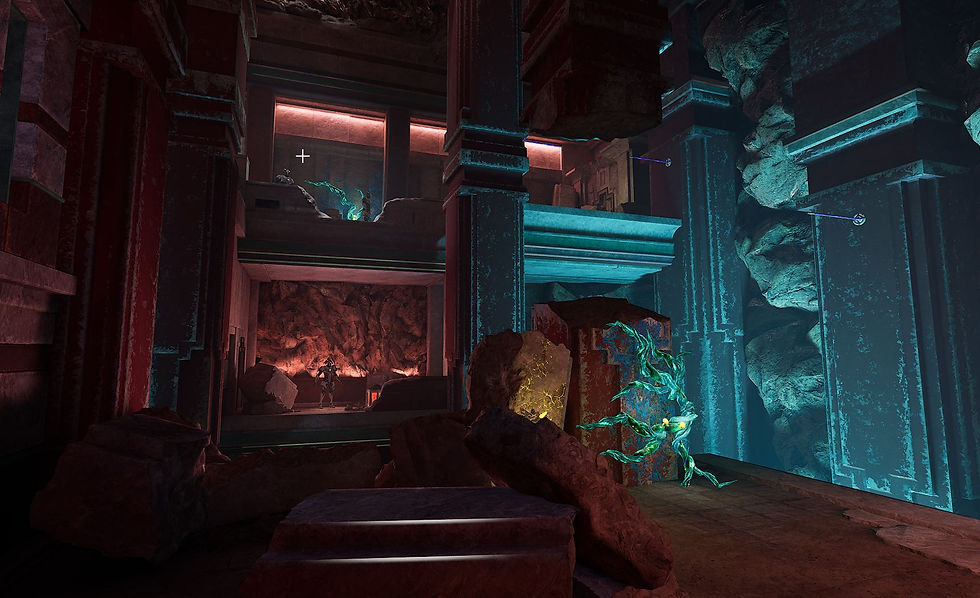
Almost all enemies spawn in front of the player, between them and the next obvious route to take, maintaining that sense of forward momentum. Additionally, as the player progresses, Lithos taunts the player and destroys pillars in the room. These broken pillars unlock new sightlines, revealing enemies and the path ahead to the player only when they’ve progressed enough.

Resources are plentiful. Healing mushrooms are scattered throughout every level of the room, and elemental grubs mean the player has a constant supply of elemental arrows, catering for both high- and low-skilled players.

All of this combines to create an encounter unlike anything else in Reach. The player constantly moves forward as they clear out enemies, progressing further and further up the room while Lithos changes the arena around them. The player feels empowered, utilising everything they’ve learned in previous encounters to overcome this one.


Comments